





Swipe to browse files.



Amadé Bertrand
Mode: Research
Source: NYT KC

Thrive
Headquarters:
San Francisco, California
Number of Locations:
11,713
Area Served:
80 Countries
Key People:
Cory Grouf (CEO) Sandra Kim (COO)
Revenue:
$142.5 Billion
Operating Income:
$44.2 Billion
Products:
Health Beverages
Number of Employees:
254,000
Corporate Profile: Thrive Corporation
Thrive Corporation is a San Francisco-based American multinational chain of pharmacological beverage bars. Founded in 2073 by GeneTech co-founder Cory Grouf, the company operates as a wholly owned subsidiary of the global genetics giant. While Ms. Grouf serves as CEO, day-to-day operations are managed by Sandra Kim, the former head of GeneTech’s pharmaceutical division.
Concept and Operations
Ms. Kim conceived of Thrive as a modern alternative to traditional bars and coffeehouses. The stores offer a variety of beverages engineered to support physical health, modulate mood, and enhance cognitive functions like attention and concentration. The company currently operates 11,713 stores across 60 countries, with 5,354 locations in the United States. Its aggressive expansion strategy sees an average of 14 to 16 new store openings per day.
The "Formulator" Model
In a departure from the industry-standard reliance on robotic labor, Thrive employs human "formulators.” These staff members craft bespoke beverages based on customer objectives, ranging from relaxation to physical exercise to "elevated consciousness." To achieve this, formulators use customer health data provided directly by the patron or gathered via sensors embedded in the service counters.
Composition and Regulation
The foundation of all Thrive products consists of genetically engineered pharmaceuticals developed by GeneTech. These substances are approved by major regulatory bodies, including: The World Health Organization, the US Food and Drug Administration, the European Medicines Agency, and China’s National Medical Products Administration.
While the exact ingredients remain a closely guarded trade secret, industry analysts suggest many components are derived from the juices of genetically modified flora.
Market Expansion and Accessibility
A pivotal shift occurred in 2074 when the North American Health Insurance System (NAHIS) approved Thrive beverages for coverage under standard medical plans. This move was later adopted by national health systems in Europe and Asia, and dramatically expanded Thrive's market share, making the products accessible to citizens on Universal Basic Income who previously found the beverages cost-prohibitive.
Design and Social Impact
Thrive locations are designed as a hybrid of a private living room and a professional workspace. This aesthetic has established the stores as primary hubs for both casual social gatherings and professional collaboration.

Thallon
Headquarters:
San Francisco, California
Number of Locations:
7,500
Area Served:
80 Countries
Key People:
Cory Grouf (Chr) Rajesh Desai (CEO)
Revenue:
$35.0 Trillion
Operating Income:
$13.6 Trillion
Number of Employees:
525,500
Corporate Profile: Thallon Corporation
Thallon Corporation is a San Francisco-based American multinational construction firm with a presence in 80 countries. Established in 2068 by GeneTech co-founders Cory Grouf and Jackson Holtz, the company operates as a wholly owned subsidiary of GeneTech Corporation. Ms. Grouf serves as Chair of the Board, while Rajesh Desai leads the firm as CEO.
Origin and Bio-Structural Innovation
The concept for Thallon reportedly originated with Ms. Grouf after she studied the devastating impact of earthquakes on masonry buildings in Central Asia. In response, she developed a genetically engineered cellular system derived from several arboreal species. This system can be cost-effectively deployed to grow onto and through existing masonry, reinforcing structures so they can shift during seismic events without sustaining damage.
Over the past decade, this technology has been refined and adopted globally across earthquake-prone regions to stabilize buildings, bridges, roads, dams, and stadiums.
Advanced Biological Architecture
Today, Thallon’s capabilities have evolved from mere reinforcement to "growing" entire multi-story autonomous buildings. These biological structures integrate complex organic systems to replace traditional mechanical infrastructure:
• Climate Control: Vascular and respiratory tissues provide integrated heating and cooling.
• Illumination: Biologically based systems provide internal light.
• Fenestration: Windows are crafted from the corneal tissue of the colossal squid.
• Sanitation: Water and waste recycling systems are derived from the digestive tissues of large ruminants.
• Energy: External coatings made from chloroplasts provide power for the building’s biological systems.
• Security: Access control systems utilize undisclosed, genetically engineered materials.
The GeneTech Headquarters
One of Thallon’s flagship projects is the new GeneTech Corporate Headquarters. The facility features two towers, one 80 stories and the other 60, connected by a massive six-story arch. This arch spans nearly an entire city block at an elevation of 40 stories above street level. The structure was grown entirely from genetically engineered materials; no traditional construction methods were used in its creation.
Market Disruption and Future Initiatives
Because Thallon "grows" rather than builds its projects, it avoids traditional construction costs and significantly compresses development timeframes. This competitive advantage has allowed the firm to rapidly capture market share from legacy construction firms and achieve unrivaled revenue growth over the last ten years. Looking ahead, CEO Rajesh Desai recently announced a partnership with GeneTech’s climate solutions division. The initiative will focus on large-scale biological shoreline protection and reclamation systems designed to shield coastal cities from climate-driven sea-level rise.

Eden, After the Fall
Headquarters:
San Francisco, California
Number of Locations:
1
Area Served:
NA
Key People:
Unknown
Revenue:
Unknown
Operating Income:
Unknown
Products:
NA
Number of Employees:
Unknown
Establishment Profile: Eden, After the Fall
Eden, After the Fall is an exclusive private club situated in downtown San Francisco. It occupies the apex of the Auberge Privée, a boutique hotel renowned for hosting high-profile and affluent patrons. Access to the club is strictly limited to members and their invited guests.
Membership and Ownership Enigmas
The club operates with a level of secrecy unusual even for San Francisco’s elite social circles. The process for joining is entirely opaque; the organization maintains no public offices, website, or contact information in any known database. Ownership remains a matter of speculation. Persistent rumors suggest the club is the property of an unnamed GeneTech executive, though the Times has been unable to verify this connection.
Architectural Anomalies
While no internal photography or video of the club exists, public building plans for the Auberge Privée reveal several peculiar details. The club spans the top three floors of the hotel and features a massive central atrium connecting the levels. Publicly filed plans do not indicate any elevators or staircases within the club's footprint. While the primary entrance is located on the top floor, hotel elevators provide no service to two of the club’s three levels, leaving the method of inter-floor transit a mystery.
Interior Atmosphere and Aesthetics
Guest accounts describe a meticulously crafted immersive environment.
The "Rainforest": The interior reportedly resembles a tropical rainforest, complete with large-scale trees and a free-roaming population of monkeys and tropical birds.
Entertainment: The bottom level features a large dance floor and live musical performances.
Performers: Dancers, dressed in "safari attire," perform on elevated platforms constructed from woven plant material.
The Entrance: The club’s threshold is marked by a dense "vinewall," where the name Eden, After the Fall is spelled out using living foliage.
Clientele
The specific membership roster is unknown. However, the Auberge Privée is a known hub for global business leaders, high-ranking political figures, and prominent individuals within academia and the arts.
Note: The photograph included in this profile was provided to the Times by a guest acting as a confidential source. It is not, however, known if the photograph depicts the actual entrance portal to the club or was generated by AI based on the guest’s memory of the experience.
TBV
Headquarters:
Jonesboro, Georgia
Number of Locations:
16
Area Served:
South / Southwest
Key People:
Rev. Cornelius Graves
Rev. Terry Graves
Membership:
60,000
Revenue:
Unconfirmed
Number of Employees:
1,458
Religious Organization Profile: Church of Traditional Biblical Values (TBV)
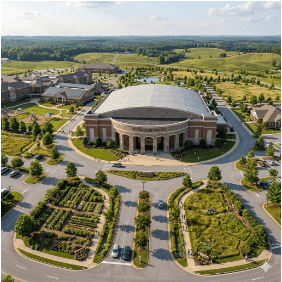
The Church of Traditional Biblical Values, commonly known as the TBV, is a non-denominational evangelical Christian megachurch. Founded in 2059 by Cornelius Graves, the organization is headquartered on a massive two-square-kilometer campus in Jonesboro, Georgia. The site features a 5,000-seat auditorium, a K-12 school and multiple administration buildings.
Scale and Influence
The TBV is currently ranked among the top 10 churches in the United States. The church self-reports over 60,000 members with a global weekly viewership in the millions. Beyond its Georgia base, the TBV operates over a dozen campuses across the American South and Southwest, with active plans for European expansion. Reverend Graves hosts a weekly video program, God and You, which has viewers in more than 20 countries.
Theological and Social Stance
The TBV preaches a doctrine of strict biblical adherence. The church maintains a hardline stance against homosexuality and same-sex marriage, positions that many contemporary religious peers view as extreme and unaligned with American values. A primary tenet of TBV teaching is that the genetic alteration of human beings is a violation of divine law.
Legal Conflict and Radical Ties
The church's anti-genetic stance has placed it under significant scrutiny from law enforcement and political bodies. In the current legal landscape, inciting boycotts or violence against genetic engineering firms or their products is a prohibited offense. Persistent, unconfirmed rumors link the TBV to the Soldiers of God, a shadowy extremist group that advocates for violent kinetic action against the architects and corporations of the genetic revolution.
History and Leadership
The TBV’s influence has fluctuated significantly over the last two decades. A decade ago, the church faced a period of sharp decline. Reverend Graves intended to hand leadership to his eldest son, Neil, but the plan was aborted following Neil’s death in a tragic accident. Forced to remain at the helm, Graves successfully revitalized the organization, doubling its membership and dramatically stabilizing its finances. While growth has recently plateaued, the TBV remains a potent force. Research suggests its unambiguous message resonates strongly with populations who feel economically and socially displaced by the advancements in AGI, robotics, and genetic engineering.

GeneTech
Headquarters:
San Francisco, California
Key People:
Cory Grouf (CEO)
Jackson Holtz (CSO)
Revenue:
$200 Trillion
Operating Income:
$77.49 Trillion
Subsidiaries:
Thallon Corp.
Bioenyo Corp.
Mercurial Corp.
Thrive Corp.
Apron Corp.
Number of Employees:
3,849,500
Corporate Profile: GeneTech Corporation
GeneTech Corporation is the largest commercial enterprise on Earth. Founded in 2066 by Dr. Cory Grouf and Dr. Jackson Holtz, the firm has achieved total market dominance across eighty countries, reporting annual revenues of $200 trillion. Its portfolio is unparalleled, spanning pharmaceuticals, healthcare, construction, agriculture, green energy, climate remediation, and military defense.
Scientific Genesis
The company’s foundation rests on Dr. Grouf’s revolutionary post-doctoral work at Stanford University, where she created the first functional digital model of the human body at the subcellular level. This simulation allowed GeneTech to develop and test drugs without human subjects. By mapping the genetic manipulation of DNA, RNA, and mRNA, the firm successfully eliminated most major illnesses, including all forms of cancer. GeneTech’s age-reversal treatments allow patients to maintain the health and appearance of someone decades younger. While Dr. Holtz suggests human life could be extended indefinitely, some scientists hypothesize a practical limit to cognitive renewal.
Bio-Industrial Disruption
GeneTech is defined by its ability to disintermediate incumbent industries by replacing mechanical and chemical processes with biological ones. For example, Thallon Corporation, a subsidiary that "grows" buildings, replaced traditional construction techniques with cellular mechanisms. Prior to Thallon disrupting the construction industry, GeneTech changed the agricultural industry with the introduction of the Multi-Adaptive Farm Bio System (MAFBS).
Believed to be engineered from the DNA of great apes, octopodidae, and broad-leaf plants, these “grown” workers are specifically designed for agricultural labor. More cost effective and efficient than human workers or robots, MAFBS rapidly reshaped the agrobusiness. A new line of XenoMats (Xenogeneic Material), designed for hazardous or dangerous work environments, is rumored to be forthcoming.
Global and Social Impact
GeneTech’s influence extends into the very fabric of society and the environment. The firm has helped to mediated climate change through the deployment of massive, genetically engineered algae mats that float on ocean surfaces and absorb vast quantities of CO2. Unconfirmed reports claim GeneTech’s military subsidiary, Bioenyo Corp., has created systems for the US Army and Navy that integrate biologic computers and nervous systems into mechanical robots and combat hardware, though neither GeneTech nor the Department of Defense has officially confirmed such reports.
In partnership with the US government, GeneTech’s "Family Farm" program has successfully returned UBI recipients to arable land using MAFBS labor, earning the company praise across the political spectrum. But a sharp social divide persists. Because age-reversal and physical alteration treatments are not covered by national health insurance, they remain a luxury of the wealthy, aggravating tensions between the career class and those on Universal Basic Income.
USER: AMADE BERTRAND
SOURCE: NYT KC // MODE: RESEARCH

Headquarters
Number of Locations
San Francisco,
California
11,713
Area Served
60 Countries
Key People
Cory Grouf, CEO
Sandra Kim, COO
Revenue
$142.5 Billion
Operating Income
$44.2 Billion
Products
Health Beverages
Number of Employees
254,000
Corporate Profile: Thrive Corporation
Thrive Corporation is a San Francisco-based American multinational chain of pharmacological beverage bars. Founded in 2073 by GeneTech co-founder Cory Grouf, the company operates as a wholly owned subsidiary of the global genetics giant. While Ms. Grouf serves as CEO, day-to-day operations are managed by Sandra Kim, the former head of GeneTech’s pharmaceutical division.
Concept and Operations
Ms. Kim conceived of Thrive as a modern alternative to traditional bars and coffeehouses. The stores offer a variety of beverages engineered to support physical health, modulate mood, and enhance cognitive functions like attention and concentration.
While the exact ingredients remain a closely guarded trade secret, industry analysts suggest many components are derived from the juices of genetically modified flora.
The company currently operates 11,713 stores across 60 countries, with 5,354 locations in the United States. Its aggressive expansion strategy sees an average of 14 to 16 new store openings per day.
Market Expansion and Accessibility
A pivotal shift occurred in 2074 when the North American Health Insurance System (NAHIS) approved Thrive beverages for coverage under standard medical plans. This move was later adopted by national health systems in Europe and Asia, and dramatically expanded Thrive's market share, making the products accessible to citizens on Universal Basic Income who previously found the beverages cost-prohibitive.
THRIVE
+


Corporate Profile: Thrive Corporation
Thrive Corporation is a San Francisco-based American multinational chain of pharmacological beverage bars. Founded in 2073 by GeneTech co-founder Cory Grouf, the company operates as a wholly owned subsidiary of the global genetics giant. While Ms. Grouf serves as CEO, day-to-day operations are managed by Sandra Kim, the former head of GeneTech’s pharmaceutical division.
THALLON
+
Corporate Profile: Thrive Corporation
Thrive Corporation is a San Francisco-based American multinational chain of pharmacological beverage bars. Founded in 2073 by GeneTech co-founder Cory Grouf, the company operates as a wholly owned subsidiary of the global genetics giant. While Ms. Grouf serves as CEO, day-to-day operations are managed by Sandra Kim, the former head of GeneTech’s pharmaceutical division.
EDEN AFTER THE FALL
+
Corporate Profile: Thrive Corporation
Thrive Corporation is a San Francisco-based American multinational chain of pharmacological beverage bars. Founded in 2073 by GeneTech co-founder Cory Grouf, the company operates as a wholly owned subsidiary of the global genetics giant. While Ms. Grouf serves as CEO, day-to-day operations are managed by Sandra Kim, the former head of GeneTech’s pharmaceutical division.
TBV
+
Corporate Profile: Thrive Corporation
Thrive Corporation is a San Francisco-based American multinational chain of pharmacological beverage bars. Founded in 2073 by GeneTech co-founder Cory Grouf, the company operates as a wholly owned subsidiary of the global genetics giant. While Ms. Grouf serves as CEO, day-to-day operations are managed by Sandra Kim, the former head of GeneTech’s pharmaceutical division.
GENETECH
+
Corporate Profile: Thrive Corporation
Thrive Corporation is a San Francisco-based American multinational chain of pharmacological beverage bars. Founded in 2073 by GeneTech co-founder Cory Grouf, the company operates as a wholly owned subsidiary of the global genetics giant. While Ms. Grouf serves as CEO, day-to-day operations are managed by Sandra Kim, the former head of GeneTech’s pharmaceutical division.